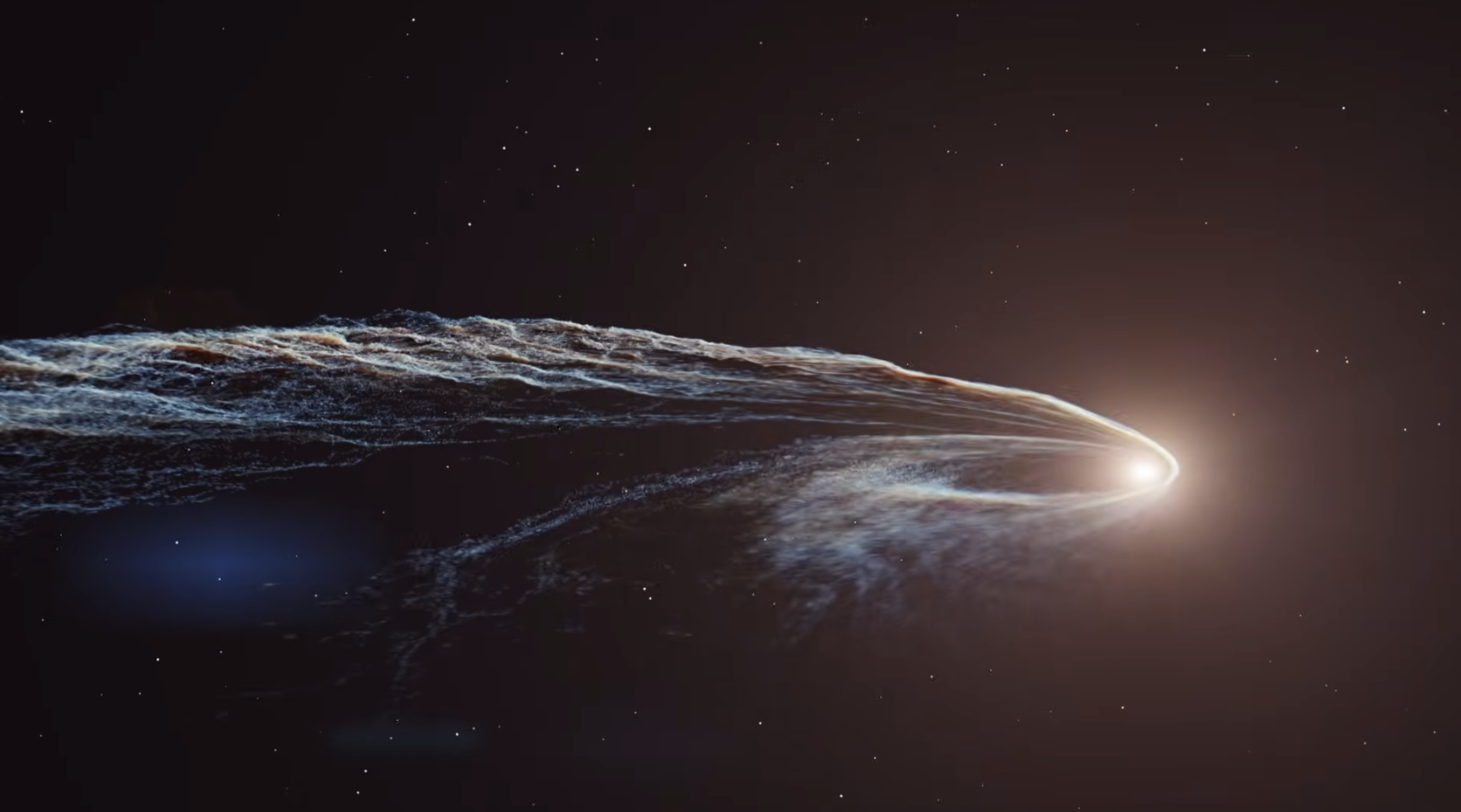
Artist's impression of a tidal disruption event. This is a frame from an animation by the Deutsches Elektronen-Synchrotron research centre (DESY) and the Science Communications Lab. Image flipped to match the other images in this item.
A recent paper published in the international journal "Astronomy and Astrophysics" discusses the discovery of the second-closest tidal disruption event ever observed, and the major role the Liverpool Telescope (LT) played in its analysis at optical wavelengths.
The paper "Early emission characterization of TDE 2025aarm", Simongini et al, A&A, June 2026, presents the first detailed study of TDE 2025aarm, a tidal disruption event (TDE) wherein stars wander sufficiently close to a supermassive black hole (SMBH) to be torn apart by tidal forces. In a TDE, the fraction of stellar debris that remains gravitationally bound falls back onto the SMBH and eventually forms an accretion disk. These events are accompanied by a huge flare in luminosity — rising sharply at disruption, then slowly decreasing over weeks/months as the elliptically-orbiting stellar debris either interacts with and joins a pre-existing accretion disc, or self-interacts through relativistic precession and circularises to form an accretion disc.
At a distance of only around 61 million parsecs (200 million light years), this is the second-closest TDE ever discovered, offering a valuable opportunity for detailed observations across optical, ultraviolet and X-ray wavelengths.
A major strength of the study is its extensive monitoring with the LT, which provided three epochs of spectroscopy using its SPRAT instrument. These observations were very important in characterizing this TDE and (as of July 2026) are the only spectra of it. They formed the backbone of the early spectral analysis, allowing the team to identify the characteristic hydrogen and helium emission lines, follow how they changed with time, and compare the event with previously observed tidal disruption events.

Artist's impression of successive stages of a tidal disruption event. The sequence begins just after the first encounter. Annotated frames from video by NASA’s Goddard Space Flight Center/Chris Smith (USRA/GESTAR). Annotation by J. Marchant.
The LT spectral data were combined with photometric observations from several other facilities, including the Zwicky Transient Facility (ZTF), telescopes from the Asteroid Terrestrial-impact Last Alert System (ATLAS) and the Swift satellite. Together, these multi-wavelength observations showed that the event consists of the fallback of a ~0.16 solar-mass star onto a ~20 million solar-mass black hole.
Analysis of the spectra showed a hot blue continuum together with broad hydrogen and helium emission lines typical of H+He tidal disruption events. Using models fitted to the observed light curves, the authors conclude that the disrupted object was probably a low-mass star (around 0.16 times the mass of the Sun) that was destroyed by a supermassive black hole of about 20 million solar masses. The observations suggest that the early optical and ultraviolet emission was powered primarily by shocks created as stellar debris collided while forming an accretion disc, rather than by material immediately falling into the black hole.
The combination of bright optical emission and relatively weak X-rays indicates that the black hole's accretion disc was still forming during the observations. A delayed accretion scenario best explains the data, with the X-ray emission expected to strengthen as the disc becomes fully established.
This TDE's proximity has enabled an exceptionally deep multiwavelength characterization, including the detection of soft X-ray emission that would likely have remained undetected at greater distances. The high-cadence optical photometric and spectroscopic monitoring by the LT and other facilities provides an unusually detailed view of its temporal and spectral evolution. The authors emphasise the importance of coordinated follow-up observations for future TDE studies.