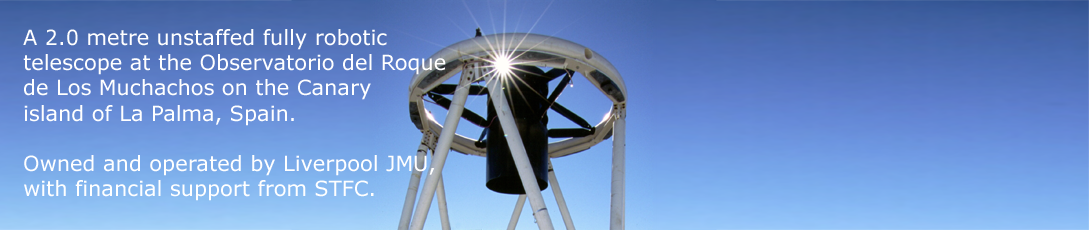
The Liverpool Telescope is a 2.0 metre unmanned fully robotic telescope at the Observatorio del Roque de Los Muchachos on the Canary island of La Palma. It is owned and operated by Liverpool John Moores University, with financial support from STFC.
LIRIC data & cooling issue
Tue 11th August — All LIRIC data obtained since July's maintenance visit are now in the process of being reduced and made available. Meanwhile, a coolant issue and the current warm weather on site mean LIRIC is running warmer than usual, and data is correspondingly somewhat noisier. This matter should be resolved on the next maintenance visit in September, and LIRIC users are advised that data quality will be reduced until then. We apologise for any inconvenience that this might cause.
Update Thu 17th Sep — The maintenance visit is scheduled for 15-22 October.

30 July 2026
A recent paper in A&A discusses the second-closest tidal disruption event ever observed, and the major role the Liverpool Telescope played in its characterisation. The LT observations plus ancillary data from other facilities show the event consists of the fallback of a ~0.16 solar-mass star onto a ~20 million solar-mass black hole. [more details]
9 June 2026
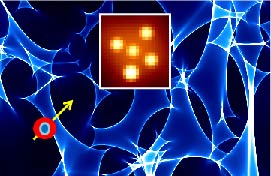
Update to a previous news item on observations of a lensed quasar by the LT and the Maidenak Telescope. A new paper by the same team describes how the dataset has been extended to now cover the 30 years up to 2024, and that a new analysis method is revealing more about the quasar's central engine. [more details]

3 March 2026
Two recent papers by LJMU astronomers detail the involvement of the Liverpool Telescope in helping scientists understand a class of very rare and mysterious cosmic explosion. The LT was one of the first of a cadre of facilities to image a recent Luminous Fast Blue Optical Transient (LFBOT). These are a growing class of enigmatic energetic transients that do not fit into the known categories of stellar explosions, and there is currently no consensus on the nature of these objects. [more details]
5 January 2026
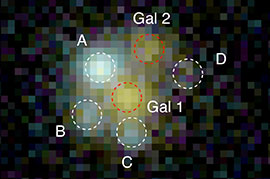
LJMU Astrophysics Research Institute astronomers using the LT have made the first ground-based observation of a gravitationally lensed supernova in another galaxy. The supernova appears as four discrete time-shifted images, studies of which may settle debates on the nature of the dark energy force thought to be behind the universe's accelerating expansion rate. [more details]
14 Oct 2025
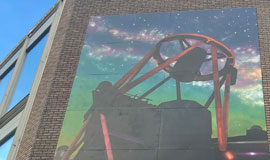
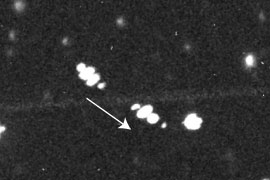
A mural of the LT was created recently by well-known Liverpool street artist Paul Curtis, and is on display in the city centre. It can be seen above the entrance to the Roxy Ballroom on College Lane, at the junction with Hanover Street. [more details]
13 Oct 2025
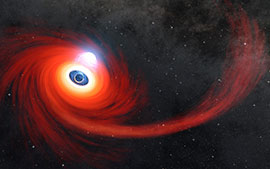
As an update to our April news item about Gaia, we can now reveal that LT observations made at the time showed Gaia likely started wobbling or tumbling after its deactivation. Image sequences showed magnitude oscillating greatly instead of keeping steady, suggesting Gaia might be precessing and/or nutating, or even tumbling end-over-end. [more details]
11 Aug 2025
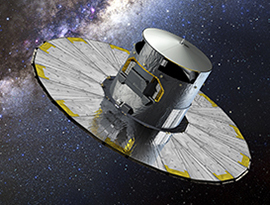
The LT was recently used to conduct a polarimetry monitoring campaign that targeted bright, long-lasting optical flares at the centres of five active galaxies. Debate exists on the physical mechanisms behind these transient events, and these new observations go some way to address the issues. [full story]
16 Apr 2025
March 27th saw the European Space Agency switch off the Gaia spacecraft, ending one chapter of a mission that, thanks to its incredibly precise observations, continues to revolutionise our understanding of the Milky Way galaxy we live in. Gaia's precision depended in part on regular and accurate ground-based tracking of the spacecraft itself, a project in which the LT played a role for 12 years. [full story]

29 Sep 2024
The LT was offline for three weeks recently (22 Aug to 13 Sep) for a major bout of scheduled maintenance. Top of the long list of tasks was realuminising the 2-metre primary mirror using the nearby aluminising plant at the William Herschel Telescope (WHT) facility. This is no small feat — the mirror must be hoisted out of the top of the enclosure through a narrow gap, and despite weighing 1.35 tonnes it can still be blown by the wind. [full story]

29 Apr 2024
Twenty years ago, on 22 April 2004, a key milestone in the commissioning of the Liverpool Telescope was passed when control of the night was handed over to the LT's robotic scheduler for the first time. First light for the telescope was achieved in the summer of 2003, but the beginning of robotic observing is really the birth of science operations at the telescope. [full story]

15 Jun 2023
The New Robotic Telescope (NRT) team welcomed two new members of staff this month. Dr Chloé Miossec joins from the University of Liverpool full-time as Instrument Scientist, and Dr Richard Ashley joins part-time from the Isaac Newton Group of Telescopes as Visiting Research Fellow. Overall group director Prof Iain Steele will now devote all of his time to ensuring the successful delivery of the NRT project, while Dr Chris Copperwheat is stepping into the role of Director of the Liverpool Telescope to lead the daily running of the facility. [full story]

14 Jun 2023
One of the closest supernovae in the last decade appeared in our skies a few weeks ago. Liverpool Telescope user Dr Dan Perley classified it as a type II supernova within hours of first detection thanks to the LT's flexible scheduling capabilities and instrumentation. An aggressive LT observing campaign is under way, and all data is being released to the public immediately. Read more for further details of the observations and how you can download the data for yourself as the months-long explosion evolves. [full story]

3 Apr 2023
An explosion the size of our solar system has baffled scientists, because part of its shape — similar to that of an extremely flat disc — challenges everything we know about explosions in space. [full story]

28 Mar 2023
Last October, astronomers witnessed the brightest gamma-ray burst ever seen by human instruments. A recent paper by Tanmoy Laskar et al ("The Radio to GeV Afterglow of GRB 221009A"), recently published in the Astrophysical Journal Letters as part of a special issue on this remarkable cosmic event, describes how the evolution of the fireball was tracked by an international group of astronomers and observatories, including the LT. [full story]

13 Feb 2023
A recent paper by Ian McHardy et al reveals insights into the structure of the accretion disc surrounding the supermassive black hole at the centre of the active nucleus of galaxy NGC 4395. Based on initial observations by the LT and followup by Gran Telescopio de Canarias, this is the first ever observation of a truncated AGN accretion disc, and the discovery has implications for future research in reverberation mapping. [full story]

19 Nov 2022
NASA began its program of returning astronauts to the Moon and beyond (Mars) with the launch of the Artemis 1 mission on Wednesday 16th November. The 25-day mission will see the uncrewed Orion capsule orbit the ~Moon before returning to Earth on 11th December. The LT captured images of Orion on its way out to the Moon a day after launch. [full story]

8 Oct 2022
The Moon was observed in polarised light during a recent total lunar eclipse, using the LT's MOPTOP polarimeter. A polarisation of 2% was found, which has implications for exoplanet searches. [full story]

20 Apr 2022
An occultation of a star by Neptune's Moon Triton in 2017 has yielded data which advances our understanding of the structure of Triton's atmosphere. Comparisons with earlier events, as far back as a Voyager radio occultation from 1989, implies the atmospheric pressure might have risen in the intervening years but is now back to its 1989 level. [full story]
30 Mar 2022
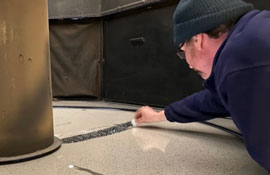
On 10th March telescope director Iain Steele and engineering manager Stuart Bates flew to La Palma for two weeks to address the most pressing maintenance tasks that had built up during two years of travel restrictions to the island. [full story]
21 Jan 2022
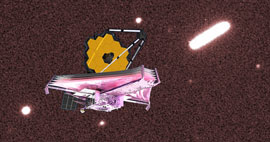
A few weeks ago one of the most exciting telescope-related events of 2021 was the launch of the James Webb Space Telescope (JWST). It began its journey with an accurate launch into L2 transfer orbit at 12:20UT on 25th December 2021, and was observed by the LT hours later as it departed Earth. [full story]
12 Jan 2022
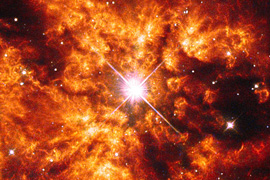
LT observations have helped unveil a previously unknown class of cosmic explosion. Research recently published in Nature and soon in the Astrophysical Journal describes the discovery of a new class of supernova — a type "Icn". [full story]
3 Nov 2021
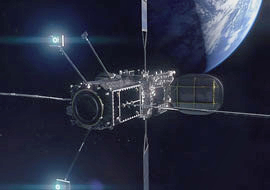
For the first time, remote-controlled spacecraft have begun servicing communications and Earth observation satellites in geostationary orbit to extend the amount of time they can remain in service. [full story]

24 May 2021
We are sad to report the death over the weekend of our friend and colleague Professor David Carter. Dave joined LJMU in 1996 as Project Scientist for the Liverpool Telescope and his determined efforts played a large part in keeping the project on track during a difficult construction phase. He was an outstanding scientist who always took a constructively sceptical approach to the prevailing consensus, and an excellent mentor to younger colleagues and students. [full story]

25 Mar 2021
A virtual tour of the Liverpool Telescope site in La Palma is on this website at the Site Tour page. You can walk around the site, even into the telescope enclosure itself, and switch between day and night views. [full story]
5 Mar 2021
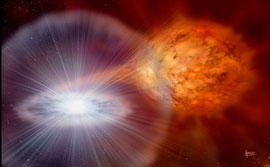
The expanding debris shells from two separate novae that were seen to erupt decades ago have been discovered and characterised in a recent paper by Éamonn Harvey et al. The paper shows that new nova shells can be found from archive data and new limited multi-epoch followup data from small to medium-sized research telescopes. [full story]