Illustration taken from the LJMU press article. Light from the supernova that would have missed the Earth is bent by the intervening galaxy's gravity to come to a focus at the Earth.
(adapted in part from LJMU press article)
LJMU Astrophysics Research Institute (ARI) astronomers using the LT have made the first ground-based observation of a lensed supernova in another galaxy.
Initial discovery of the supernova was made by the Zwicky Transient Facility (ZTF), a 1.22m optical telescope in California USA, that lacked the resolution to see that the event was actually lensed into multiple images. That higher-resolution discovery was made by the LT using its IO:O camera that was able to resolve the supernova into its four separate images.
The supernova went off in a galaxy 10 billion light years away. Light rays that would have just missed the Earth were instead bent by an intervening galaxy's gravity to come to a focus at the Earth. The gravitational lens is not perfectly symmetric so the supernova does not appear as a single distorted image but rather as four discrete images.
“When light is lensed, the different paths the light follows to get to Earth don't all have the same length, so light moving along different paths takes variable amounts of time to reach us,” said ARI PhD student Jacob Wise. He was the first to realise the supernova was lensed when studying the IO:O data.
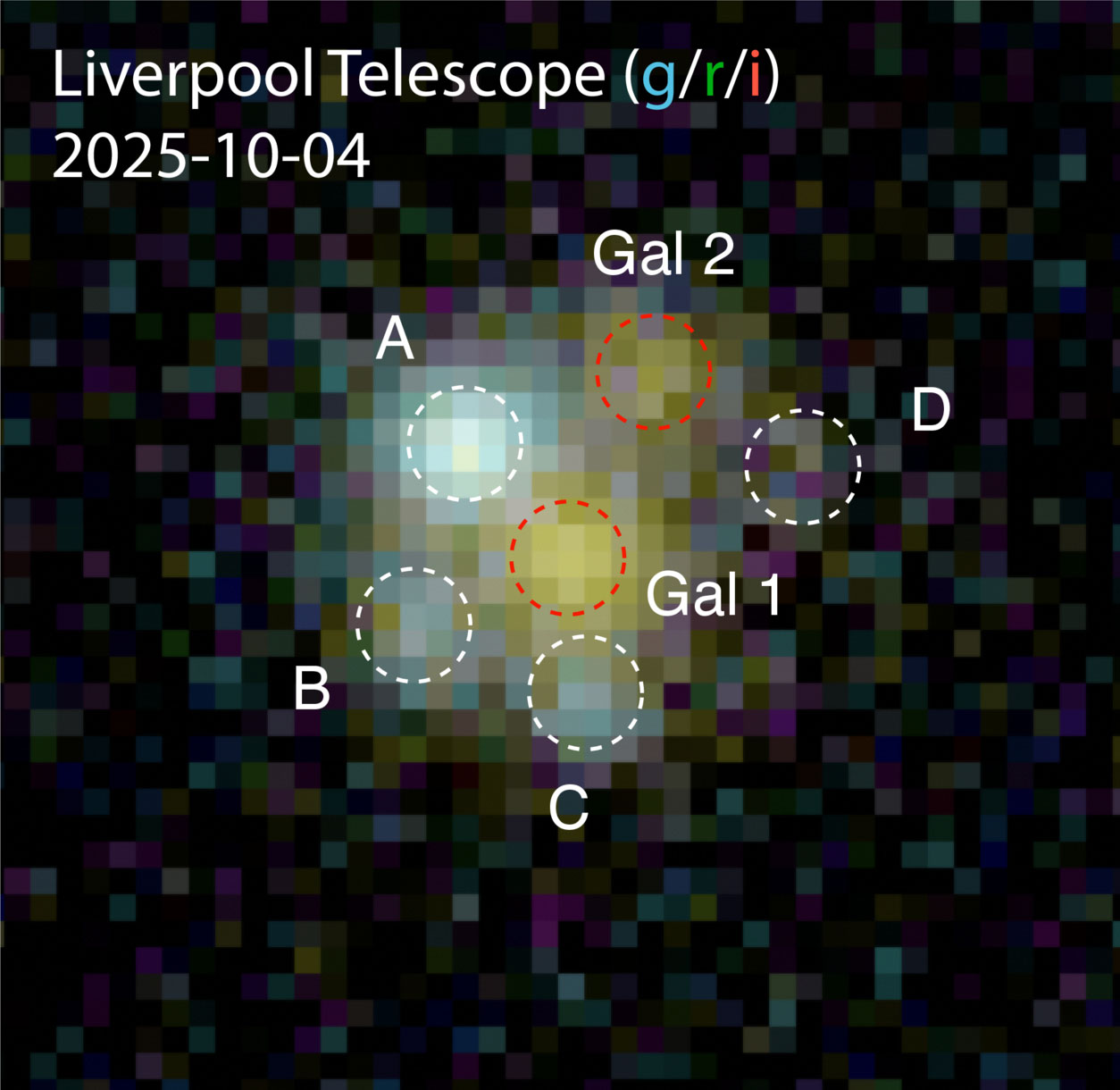
LT discovery image of the lensed supernova. It's a false-colour image made from stacked exposures through green, red and deep red filters. The multiple images of the lensed supernova are denoted A-D, and two galaxies "Gal 1" & "Gal 2" lie in the foreground. Pixels are 0.3 arcsec across. © 2025 D. Perley
Each of the four lensed images (see right) are therefore showing the same months-long supernova event, but at different points along its timeline. A rough analogy would be four TV screens showing the same movie but all out of sync with each other. As the supernova "movie" is played out, fluctuations in the most advanced image will eventually be repeated in the others.
“What's exciting about that is that the amount of time difference between different images depends on the expansion rate of the universe,” explained Dr Daniel Perley, a reader in astrophysics at the ARI.
By precisely measuring the time delay between the images, it should be possible to determine more exactly how fast the universe is expanding. This in turn would tell us about the dark energy force that is believed to cause the universe's expansion to accelerate.
There are two competing values for the expansion rate of the universe. One is based on studies of the afterglow of the big bang, the other from observations of nearby galaxies. Perley suspects this supernova calculation will help cast the tiebreaking vote, saying "studies of lensed supernovae could indicate which of these two numbers we should really believe.”
The full story is published in the journal Astrophysical Journal Letters with the title "Discovery of SN 2025wny: A Strongly Gravitationally Lensed Superluminous Supernova at z = 2.01". The authors are Joel Johansson, Daniel A. Perley, Ariel Goobar, Jacob L. Wise, Yu-Jing Qin, Zoë McGrath, Steve Schulze, Cameron Lemon, Anjasha Gangopadhyay, Konstantinos Tsalapatas, and 24 other co-authors.
The supernova is now being studied across the world. The Liverpool Telescope was the first facility to see the multiple images and thereby prove it was gravitationally lensed. It was later followed up by the Keck Telescopes in Hawaii, the Hubble Space Telescope, and the James Webb Space Telescope.
Relevant links