SkyCam
Introduction
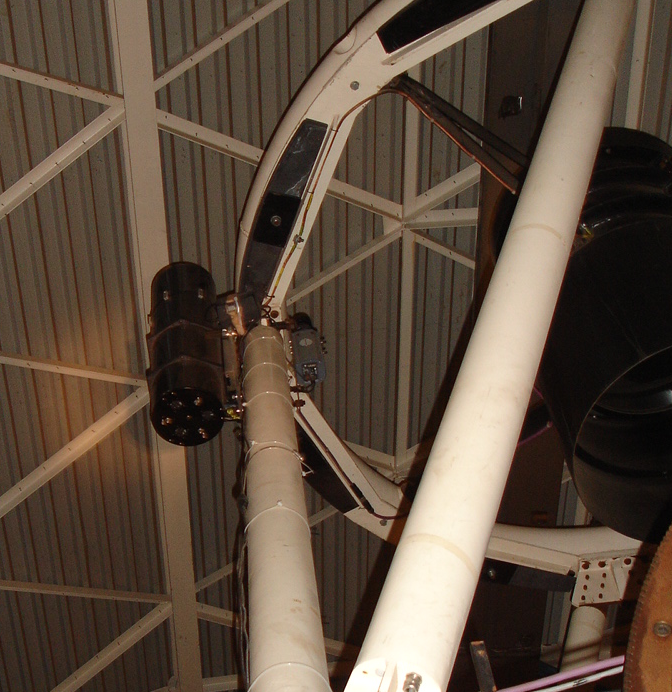 SkyCameras T and Z mounted on the top-ring of the telescope
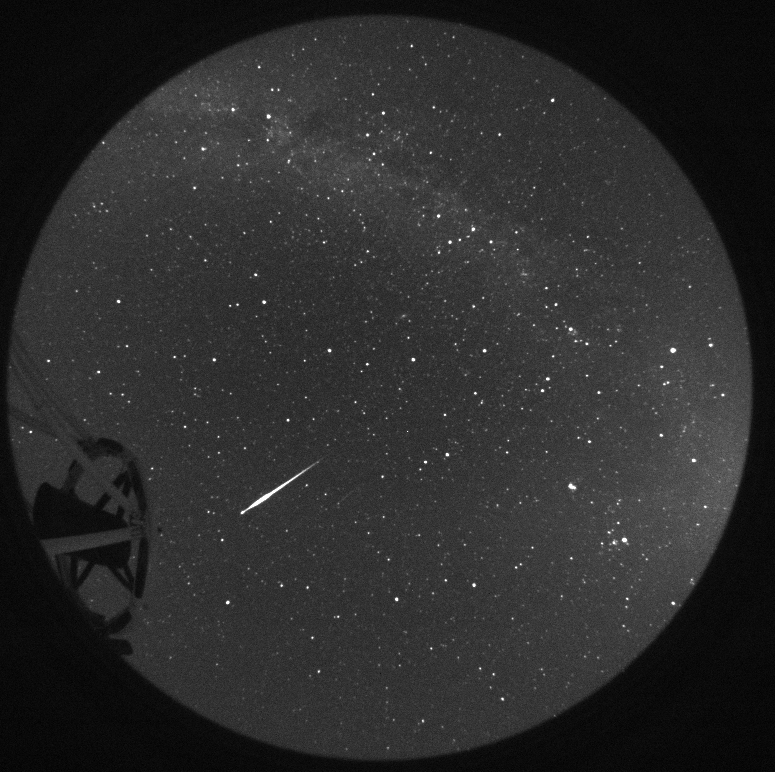
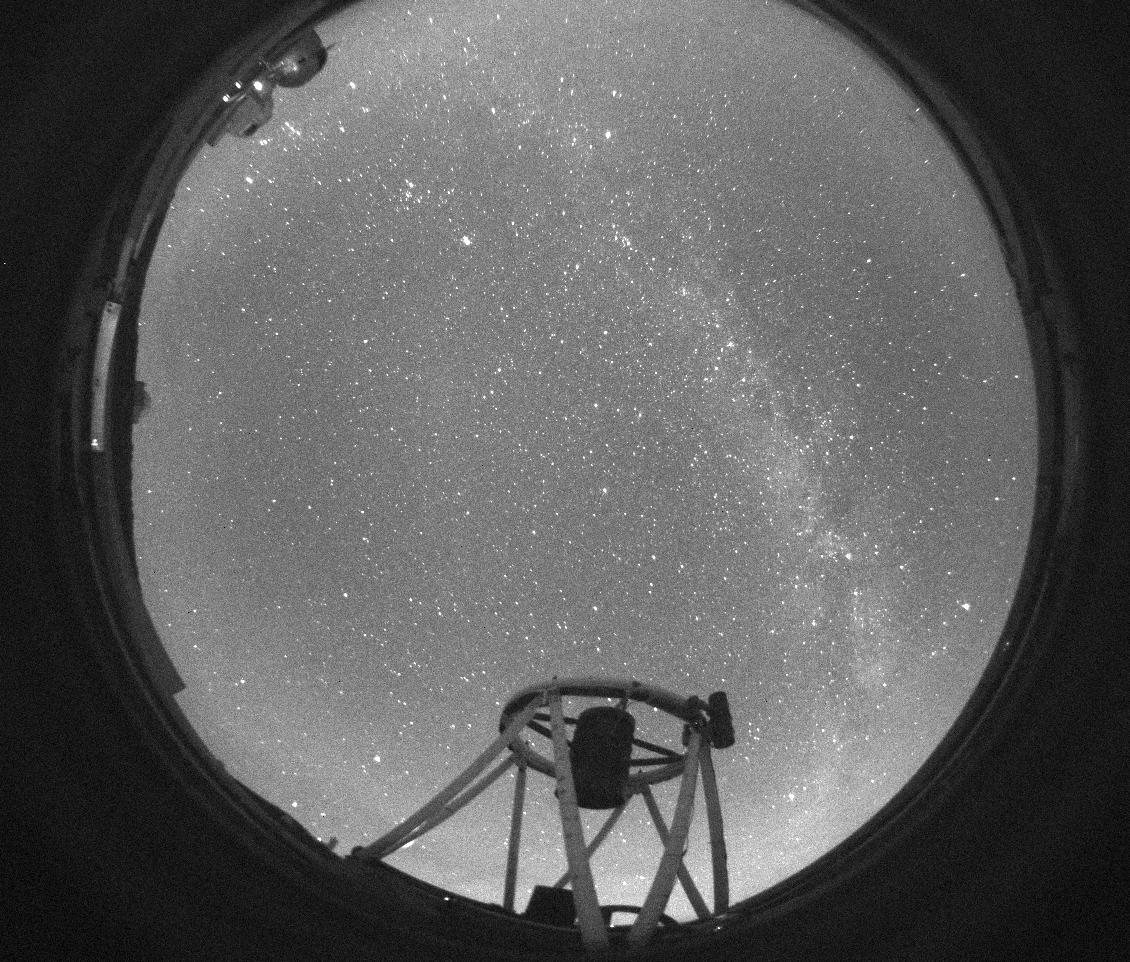
"SkyCam" is a project aimed at providing simultaneous wide-field observations in parallel with normal LT data taking. Four cameras, each offering a different field of view (FOV), are being used: SkyCam-A, mounted on the side wall of the enclosure, inside the dome and giving a fish-eye view of almost the entire sky above the telescope; SkyCam-O, an all-sky fisheye camera mounted outside the enclosure so it provides images day and night; SkyCam-T; and SkyCam-Z, both of which are mounted on the top ring of the telescope (shown right) and co-pointing with the telescope.
SkyCam-T currently offers a roughly 20 degree field-of-view. There have been several iterations of optical layout for Skycam-T: up until 22 October 2014 it had a 21° FOV; from then until Jan 2019 the FOV was 9° and from Jan 2019 the latest detector has a 24×16° FOV. SkyCam-Z uses an Orion AG8 telescope to give a finer resolution and a smaller 1° field of view.
At any given time, SkyCams T and Z image whatever field is being observed by the primary science instruments on the telescope.
All data taken with SkyCam-A and SkyCam-T are immediately public to all and may be used for any non-commercial, scientific or educational purpose. Data taken with SkyCam-Z remain proprietary. Please contact the LT group if you require access to Skycam-Z data.
All four cameras are useful for monitoring observing conditions at the telescope. Indeed, every night instrumental zero-point measurements are obtained from each SkyCam-Z and SkyCam-T exposure. A plot of these ZP measurements can be used to track changes in transparency. Whilst Skycam-A runs only at night, Skycam-O was designed specifically for the purpose of cloud tracking, both day and night. When used alongside Movies created from all images obtained with each camera, LT users should be able to qualitatively establish how clear or cloudy a given night was. These ZP plots and Movies are available from our Night Reports archive.
The information given below represents only an overview of the SkyCam system. A more detailed description of SkyCam operations, software processing and photometric reliability may be found in STILT: System Design & Performance, Mawson, Steele and Smith, 2013, AN, in press (ArXiv e-prints, arXiv:1305.0573, http://arxiv.org/abs/1305.0573) which describes one particular photometric project based on SkyCam data.
Specification
At present the system consists of three cameras:
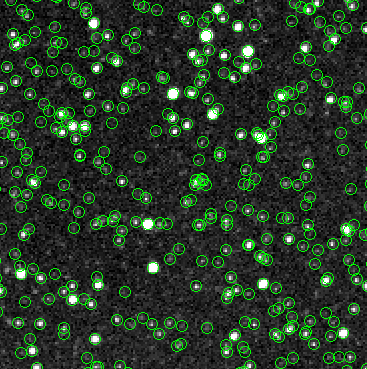 Small section of SkyCamT image with all objects brighter than V=12 identified
 (click for bigger)
- SkyCam-A – an "all sky" camera on a fixed mount inside the LT enclosure. The Andor ikon-M DU934N-BV camera (4.5mm lens; F/2.8; ~130° FOV), which was in use for a number of years, was replaced in Summer 2014 with a Starlight Xpress Oculus camera. This instrument uses a 1.55 mm F/2.0 180° fish-eye lens to provide horizon-to-horizon coverage down to about 6th magnitude. It is capable of detecting reasonably thin cirrus and on dark nights is useful for checking for the presence of clouds affecting data.
- SkyCam-O – A Raspberry Pi HD camera installed outside the Liverpool Telescope enclosure for real-time weather monitoring. This camera provides high-resolution images of the sky and surrounding environment, offering a cost-effective solution for observing local weather conditions and potential cloud coverage. SkyCam-O complements the existing SkyCam array by providing external, non-astrophysical observations to enhance operational decision-making.
- SkyCam-T – a "medium field" Starlight Xpress Trius SX-35 camera mounted on the LT top-end (see photo above) which parallel points with the telescope. This instrument currently uses a Zeiss Planar T 85mm f/1.4 ZF2 lens which yields a pixel scale of 44 arcsec, a FOV of roughly 24×16° and a detection limit of V~12 mag. Previous generations of camera have used various combinations of optics and detector arrays, but always with the FOV in the range of 10–20°. This camera is arguably the most useful of the three for tracking passing clouds.
- SkyCam-Z – As of September 2024, this has a ZWO ASI174MM monochrome uncooled CMOS camera mounted on an Orion Optics AG8 telescope next to SkyCam-T. Like SkyCam-T, SkyCam-Z parallel points with the telescope. The current set-up provides a 0.84×0.55° field-of-view with a plate scale of 1.62 arcsec/pixel. SkyCam-Z can detect stars down to about 17th magnitude, complete to R~16.5, and often yields spectacular images of galaxies and nebulae.
The following information may be of use when looking at older Skycam data. This detector is no longer in use.:
The Andor ikon-M DU934N-BV cameras used in some previous generations of SkyCam-T/Z contain 1024x1024 pixel, back illuminated and anti-reflection coated CCDs, running at -40°C. A quantum efficiency curve is presented at right. No filters are used with any of the cameras. Gain and readnoise measurements are available upon request.
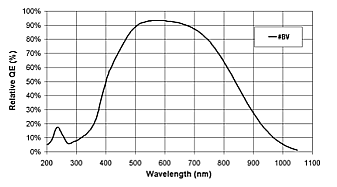
Skycam CCD QE curve.
Pipeline
When the enclosure is open, a 10 sec exposure is taken automatically once per minute with Skycam-T and Skycam-Z. Skycam-A uses 30sec. Skycam-O runs day and night, whether or not the dome is open, and adjusts its exposure time dynamically, depending on the light level. All data are automatically dark subtracted and flat-fielded and a world coordinate system fitted. Skycam-Z data remain proprietary. However, SkyCam-A, Skycam-O and SkyCam-T data are then immediately released, both as JPEG and FITS files here. In addition both browsable ( 2026; 2025; 2024; etc) and searchable image archives are available.